|
Stakeholders Section
|
 Supplier Management PolicyOur company has established procedures for sourcing, reviewing, evaluating, and managing suppliers to ensure that selected suppliers meet our requirements in terms of product quality, pricing, delivery, cooperation, service, production capacity, and environmental, health, and safety (EHS) standards. This policy is herein referred to as the Supplier Management Policy (the “Policy”). 1. Scope of Supplier Management The company implements management measures corresponding to the type of products, services, or purchase amounts provided by suppliers. 2. Supplier Management Mechanism We have established a supplier management mechanism to monitor supplier operations, reduce operational risks, and prevent potential impacts on our company. The supplier management mechanism includes the following: Supplier Evaluation
On-site Supplier Assessment
Supplier Monitoring
Deregistration of Qualified Suppliers Suppliers may be deregistered following evaluation and approval by the responsible authority under the following circumstances:
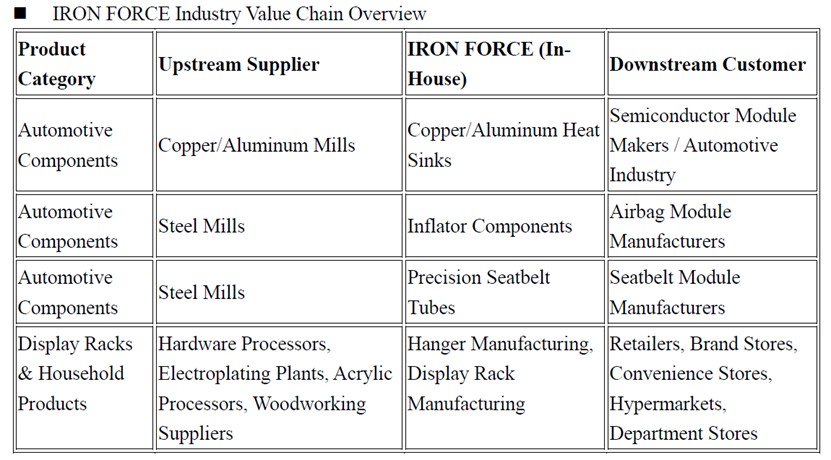
Sustainable Supply Chain ManagementSustainable supply chain management has become increasingly important for enterprises in today’s global economy. With growing public awareness of environmental and social responsibility, consumers and stakeholders hold higher expectations for companies regarding sustainable development and social impact. In this context, building a sustainable supply chain not only helps reduce corporate risk but also enhances market competitiveness and contributes positively to society and the environment. IRON FORCE, operating in the automotive components industry, mainly produces automotive parts (such as inflator housings for airbag systems and pretensioner components) and display racks. Upstream suppliers for automotive components are primarily engaged in metal processing, while downstream sectors include the automotive industry. For display racks, upstream suppliers are mainly from the steel industry, and downstream sectors include retail and department store businesses. To establish long-term and stable partnerships with suppliers, IRON FORCE has developed a Supplier Evaluation Procedure and a Supplier Environmental Assessment Management Procedure. The company maintains regular communication with suppliers through on-site or online methods. Through these efforts, IRON FORCE aims to maintain strong supplier relationships and jointly pursue maximum economic performance and value creation.
Key Documents Supplier Screening and EvaluationIRON FORCE has established supplier management procedures covering the selection of new suppliers, evaluation, and review of existing suppliers to ensure that product quality, pricing, delivery, cooperation, service, capacity, and EHS performance meet both company and customer requirements. For new supplier selection, responsible departments assess product quality, supply risk, cost, occupational safety, and social responsibility. According to the Supplier Environmental Assessment Management Procedure, particular attention is given to suppliers without ISO 14001 systems and those in industries with higher pollution potential, such as metal processing and surface treatment. Suppliers are required to provide Material Safety Data Sheets (MSDS), or comply with IRON FORCE’s Restricted and Prohibited Substances List, which is also referenced in contracts to protect both parties' interests. In 2024, two new suppliers were onboarded. The screening pass rate based on environmental and social criteria was 100%. Only suppliers passing this evaluation are qualified to become IRON FORCE’s commercial partners.
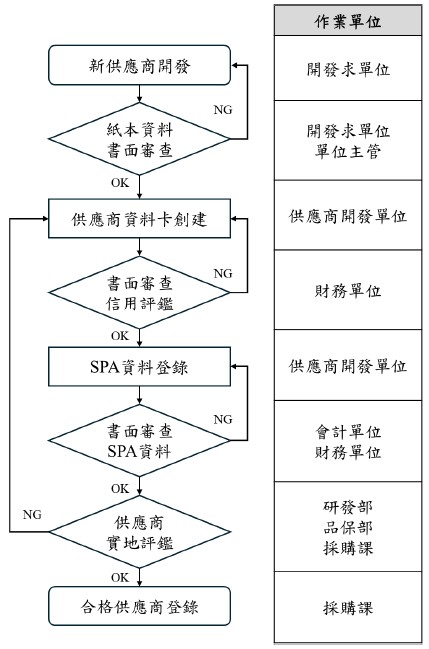
New Supplier Selection Flow
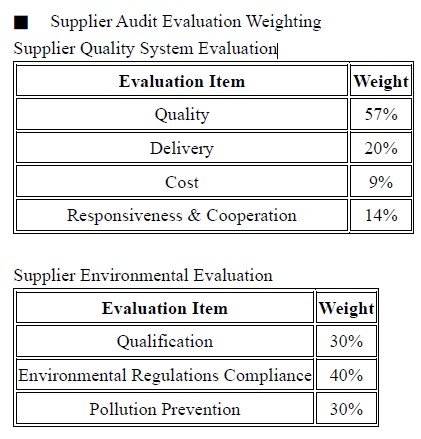
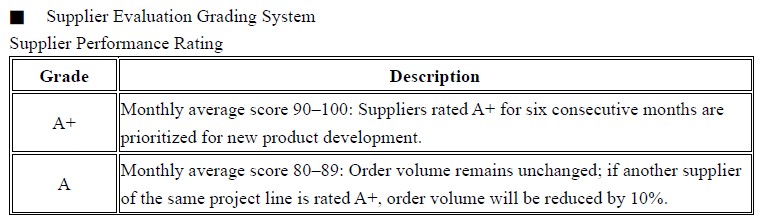
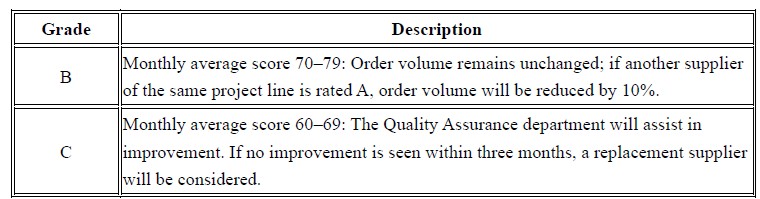
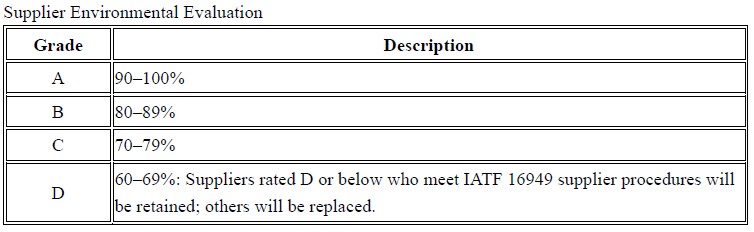
In accordance with internal supplier evaluation procedures, IRON FORCE conducts annual assessments of raw material and processing suppliers through either document audits or on-site audits, based on interviews and internal control standards. Evaluation covers quality, delivery, service, as well as occupational health and safety, and social responsibility. Suppliers without ISO 14001 certification are subject to regular environmental assessments, including qualifications, regulatory compliance, and pollution prevention measures. Supplier evaluation results are graded from A+ to C. Environmental assessment results are graded from A to D. Suppliers rated C or below (in general evaluation), or D or below (in environmental assessment), are given enhanced guidance to improve. If a supplier’s conduct is deemed potentially harmful to IRON FORCE’s reputation, the business relationship is immediately terminated. Through these evaluations, IRON FORCE aims to support supplier improvement and enhance overall satisfaction.
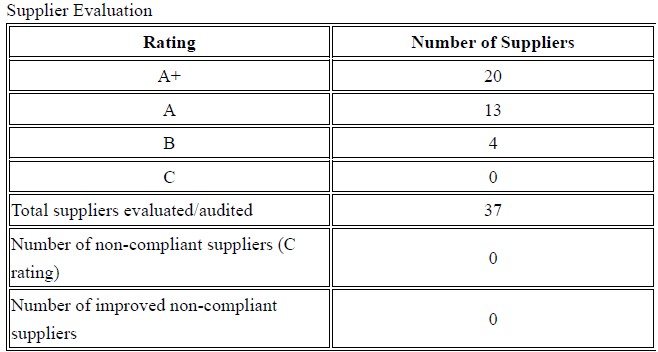
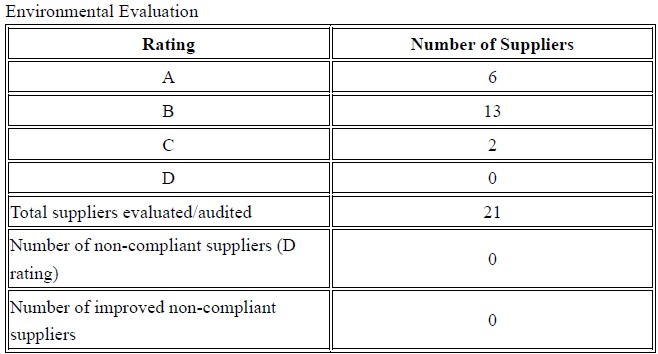
2024 Supplier Evaluation Results In 2024, IRON FORCE conducted evaluations for 37 raw material and processing suppliers. Results: 20 rated A+, 13 rated A, and 4 rated B. No non-compliant suppliers were identified. Environmental evaluations were conducted for 21 suppliers: 6 rated A, 13 rated B, 2 rated C. No non-compliant suppliers were identified.
Conflict MineralsTo uphold human rights in conflict-affected areas and address the issue of conflict minerals, IRON FORCE does not use coltan, cassiterite, gold, or wolframite sourced from the Democratic Republic of the Congo, Angola, Burundi, Central African Republic, Republic of the Congo, Rwanda, South Sudan, Tanzania, Uganda, or Zambia. The Quality Assurance Department conducts regular conflict minerals surveys of raw material suppliers. |
 1. Supplier Sustainability Management Guidelines